

Dan Parker *14 wins Bloomfield Book Award
October 27, 2026
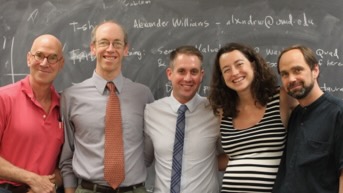
Linguistic Illusions wins LSA recognition.
Big congratulations to Dan Parker, Class of 2014, who has won the Leonard Bloomfield Book Award for his Linguistic Illusions, published in 2025 by Cambridge University Press, blurbed below. The award, given by the Linguistic Society of America, "recognizes a volume that makes an outstanding contribution of enduring value to our understanding of language and linguistics." It will be officially bestowed at the Annual Meeting, January 6-9, in San Francisco. Last year, the prize was awarded to Norbert Hornstein, for The Merge Hypothesis, making this two consecutive wins for Terrapin linguists!
Dan graduated in 2014 after finishing a dissertation on The cognitive basis for encoding and navigating linguistic structure. It was supervised by Colin, and defended to a committee of Ellen, Norbert and Jeff, plus Michael Israel representing the Graduate School. Upon graduating, Dan was immediately hired as Assistant Professor at the College of William and Mary, where he was soon joined by classmate Kate Harrigan *15, then tenured as Associate Professor in 2020. Dan then moved to The Ohio State University in 2022, where he is now a senior colleague to fellow Terrapin, Assistant Professor Katherine Howitt, Class of 2026. Dan's awarded book, "a case study in agreement attraction", provides an expert overview of the issues he first engaged at Maryland, in active conversation with the work of UMD schoolmates including Matt Wagers *08 (Santa Cruz), Ellen Lau *09, Brian Dillon *11 (UMass), Wing Yee Chow *13 (UCL) and Zoe Schlueter *17.
Linguistic illusions are cases where we systematically misunderstand, misinterpret, or fail to notice anomalies in the linguistic input, despite our competencies. Revealing fresh insights into how the mind represents and processes language, this book provides a comprehensive overview of research on this phenomenon, with a focus on agreement attraction, the most widely studied linguistic illusion. Integrating experimental, computational, and formal methods, it shows how the systematic study of linguistic illusions offers new insights into the cognitive architecture of language and language processing mechanisms. It synthesizes past findings and proposals, offers new experimental and computational data, and identifies directions for future research, helping readers navigate the rapidly growing body of research and conflicting findings. With clear explanations and cross-disciplinary appeal, it is an invaluable guide for both seasoned researchers, and newcomers seeking to deepen their understanding of language processing, making it a vital resource for advancing the field.