Matt Wagers to Maryland
October 22, 2026
Galvanizing psycholinguistics with a Laureate hire.
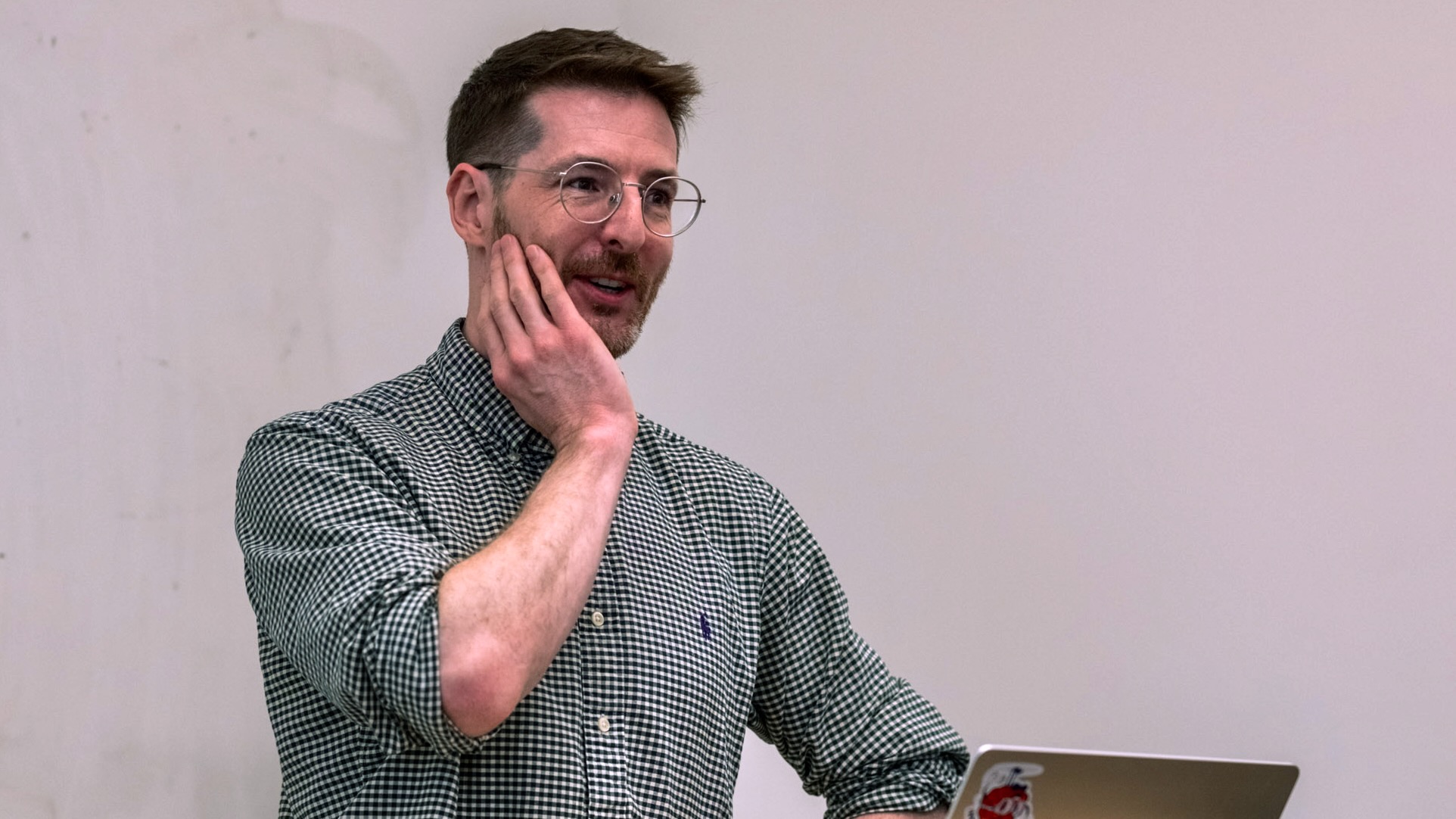
With open arms and great excitement we welcome Matt Wagers *08 back to Maryland, now as Professor of Linguistics. Matt returns with the support of the University's Laureate Initiative, which seeks to hire eminent scholars with a record of innovative research and effective mentorship. He begins in August 2027, together with frequent collaborator and fellow Terrapin, Brian Dillon *11, recently hired with the support of AIM.
A 1999 high-school graduate of the North Carolina School of Science and Mathematics, Matt came to Maryland from Princeton in Fall of 2003, recruited by Colin Phillips. He had received his bachelors degree at Princeton in Molecular Biology, augmented with certificates from the Programs in Neuroscience and Linguistics. At Maryland he began to forge connections between linguistics and research on working memory, often in conversation with postdoc Ming Xiang (Chicago), fellow PhD students Jon Sprouse *07 (NYU Abu Dhabi), Clare Stroud *08 (NIH), Diogo Almeida *09 (NYU Abu Dhabi), Ellen Lau *09 (Maryland), and Brian Dillon *11, among many others. Thanks in part to what Matt describes as "some back-of-the-room whispering with Ellen during Mark Baker’s 2005 Blackwell lectures," this led in 2008 to "The structure of memory meets memory for structure in linguistic cognition," a dissertation supervised by Colin and defended to a committee of Norbert Hornstein, Amy Weinberg and Jeff Lidz, plus Michael Dougherty representing the Graduate School. The dissertation "investigates under what conditions real-time language comprehension is grammatically accurate" and concludes that "dependencies that can only be licensed exclusively retrospectively, by searching the memory to generate candidate analyses, are the most prone to grammatical infidelity."
Immediately upon graduating, Matt was hired as Assistant Professor of Linguistics at UC Santa Cruz. But before going west – there, in the open air – he enjoyed a postdoctoral year in the Big Apple working with Brian McElree in Psychology at NYU. Some fruits of their collaboration are in "Working memory and language processing", an overview piece for the 2013 Cambridge Handbook for Biolinguistics, co-edited by fellow Terrapin Kleanthes Grohmann *00.
At Santa Cruz, Professor Wagers opened a line of research with Sandra Chung that led to their 2013 NSF grant (1251429) on "The Real-Time Grammar of Chamorro WH-Dependencies," and pioneered the use of psycholinguistic techniques "in the field", outside of major university labs in Europe and North America, with speakers of less commonly studied languages. The work, some of it described in a 2015 paper for Language, was heralded by the American Association for the Advancement of Science: in 2020 they elected Matt to be a AAAS Fellow, in recognition his "innovative research extending the methodology of experimental psycholinguistics to investigations of understudied minority languages." The august group of AAAS Terrapin linguists includes Colin, who was elected in the very same year as Matt; Jeff, who was elected in 2025; and faculty alumnus David Poeppel, who was elected while at Maryland in 2007.
Matt was promoted to Associate Professor with tenure in 2014 and then to Full Professor in 2021. During his time at Santa Cruz he has graduated eight PhD students, and was just this past Spring awarded the 2026 Excellence in Teaching Award by the UCSC Academic Senate Committee on Teaching, for "exemplary and inspiring teaching". He has delivered countless conference presentations and published more than three dozen articles, in Cognition, Language, the Journal of Memory and Language, and many other venues. In 2020 he and Ivy Sichel were Co-Principal Investigators on an NSF project (2019804) led by Maziar Toosarvandani on "Animacy and resumption at the border of cognition and grammar," which compared the grammar of resumptive pronouns in Hebrew and Santiago Laxopa Zapotec. In 2024 he joined the Co-PIs to an ongoing grant led by Pranav Anand, from the Institute of Museum and Library Services, on “Oaxacan Languages of the Transnational Central Coast." And in 2025 he published an encylopaedic review of his field of Sentence Processing in the MIT Open Encyclopedia of Cognitive Science with frequent co-author Brian Dillon *11, who arrived at UMD as a Baggett Fellow in 2005, at the outset of Matt's third year.
Having achieved all this, Matt returns to Maryland to work alongside longtime collaborators Brian and Ellen, now all three as fellow faculty, together with several of his former teachers, in a department formed in part by his work. And we are, all of us, thrilled!