
Laurel and crew in Developmental Science
May 12, 2026
Representations of non-local syntactic dependencies feed verb learning in infancy.
Now out in Developmental Science from alum Laurel Perkins *19 (Assistant Professor, UCLA) with former teachers Jeff and Alexander, and recent graduate Jack Ying *25 (postdoc, CUHK), a demonstration that "Representations of non-local syntactic dependencies feed verb learning in infancy." The paper reports research that began here at Maryland under the NSF grant to the Third Man Project (#BCS-1551629) and then continued apace at UCLA thanks to another NSF grant to Laurel, "Non-local syntactic dependency acquisition in infancy" (#BCS-2336013).
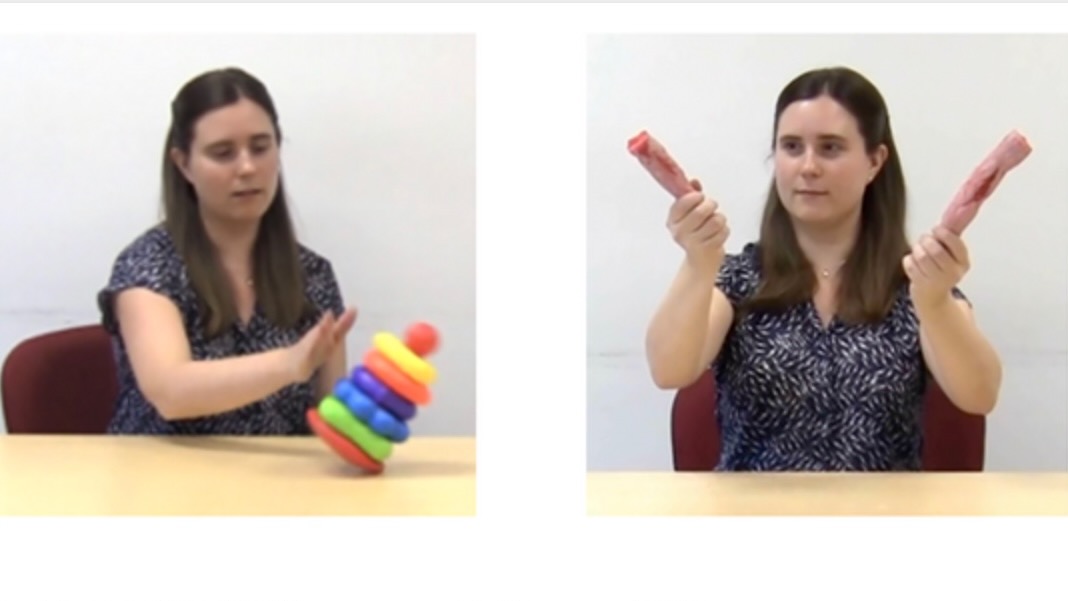
The ability to represent both local and non-local syntactic dependencies emerges in an infant’s second year of life, raising questions about how these early syntactic representations interact with language learning in other domains. Using wh-questions as our case study, we investigate how infants’ syntactic dependency acquisition interacts with their early lexical development. Prior work finds that 18-month-olds represent fronted wh-phrases as non-local arguments in object wh-questions with known verbs. Here, we show that 19- to 21-month-olds (range: 18;29- 21;26) do the same when interpreting unknown verbs. We introduce a novel Violation of Fit method, a cross-modal extension of the Violation of Expectations paradigm. Infants saw dialogues with novel verbs in object wh-questions (e.g. What is the girl gonna gorp?), transitive polar questions (Is the girl gonna gorp the toy?), or intransitive polar questions (Is the girl gonna gorp?). At test, infants viewed a causal event (e.g. a girl knocks over a tower) and we measured their attention as an indication of whether they considered the verbs to be a good fit for this type of event. Across the age range, we found that infants who heard wh-question dialogues attended similarly to the test events as infants who heard canonical transitive dialogues, and unlike infants who heard intransitive dialogues. Thus, 19- to 21-month-olds treat object wh-questions with a novel verb as transitive when relating them to scenes. This suggests that immediately after wh-dependency representations are first acquired, they are available to feed verb learning.